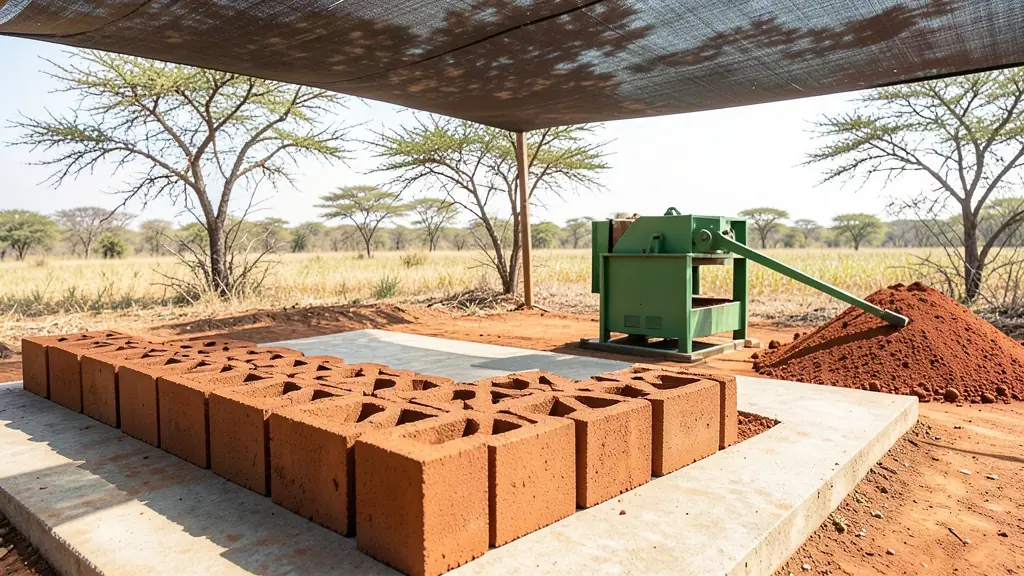
Interlocking bricks lock into each other with tongues, grooves or raised keys, so a wall can be dry stacked with little or no mortar between the courses. Many are compressed earth or soil-cement blocks pressed from local soil, a little cement and water in a manual or hydraulic press, which is why they appeal to farms, rural builders and small brick-making projects. The walls still need proper foundations, plans and good curing. Send one free, no-obligation request for bricks or a machine and suppliers near you quote you directly.
What interlocking bricks are
- Compressed earth blocks are made from sieved soil, often with a little cement to stabilise them, pressed hard in a mould.
- Soil-cement and cement interlocking bricks use more cement and sand and look more like a cement brick.
- Hollow interlocking blocks have holes that line up so steel and grout can go down through the wall at corners and openings.
Interlocking pavers are a different product; see paving bricks.
Choosing interlocking bricks or an interlocking bricks machine
If you are buying bricks, ask for the strength and whether they are stabilised, and check a sample for sharp, unbroken keys. If you plan to make them:
- Soil: test it. Too much clay shrinks and cracks; too much sand crumbles.
- Press: a manual press uses a long lever; a hydraulic press packs harder and faster but needs power or an engine.
- Mould: it sets the brick size and key pattern, so pick it before the machine.
- Output: ask the supplier for the output with your mould and crew.
Building with interlocking bricks, and common mistakes
The first course must be dead level on a proper foundation, because every course above follows it. Many builders bed the first course in mortar and add a grouted bond beam at roof height. Mistakes to avoid:
- Skipping foundations or plans because the bricks are dry stacked.
- Using unstabilised earth blocks where rain hits the wall, with no plaster or roof overhang.
- Laying bricks before they have cured.
- Bricks with chipped keys that leave the wall out of line.
SANS 10400 still applies to the building.
What affects the price, and what to ask
Brick prices are quoted per job, and depend on the soil and cement content, the size and the transport. Machines range from manual presses to hydraulic units. Ask:
- What strength are the bricks, and are they stabilised?
- Which mould and key pattern does the machine use?
- Is a soil test or training included?
- Who supplies spares and repairs?
What to include in your request
- Bricks delivered, or a machine to make them
- What you are building
- The soil on site, if making your own
- Manual or hydraulic press
- Training and a soil test included
Interlocking Bricks for different clients
- Homeowners: interlocking bricks for a garden wall, an outbuilding or a rural family house
- Builders and bricklaying contractors: a small builder trying dry stacked interlocking walls on rural houses
- Housing developers and complexes: low cost housing pilots built from stabilised interlocking blocks
- Brickyards and block yards: a yard adding a hydraulic press to sell interlocking bricks beside cement bricks
- New brick-making businesses: a co-operative or youth project pressing interlocking bricks from local soil
- Farms and smallholdings: staff houses, stores and kraal walls pressed from soil on the farm
- Municipalities, schools and public works: community halls and classrooms built with locally made interlocking blocks
- Landscapers and paving teams: dry stacked garden and planter walls from interlocking soil-cement bricks
Frequently asked questions
How much do interlocking bricks cost?
Do interlocking bricks need mortar?
Are interlocking bricks strong enough for a house?
Is making interlocking bricks a good business?
Interlocking Bricks by province and city
- Johannesburg
- Pretoria
- Centurion
- Midrand
- Sandton
- Randburg
- Roodepoort
- Krugersdorp
- Randfontein
- Germiston
- Boksburg
- Benoni
- Kempton Park
- Alberton
- Vanderbijlpark
- Vereeniging
- Durban
- Pinetown
- Pietermaritzburg
- Richards Bay
- Newcastle
- Ladysmith
- Gqeberha (Port Elizabeth)
- East London
- Kariega (Uitenhage)
- Mthatha
- Cape Town
- Bellville
- Paarl
- Stellenbosch
- George
- Worcester
- eMalahleni (Witbank)
- Middelburg
- Secunda
- Mbombela (Nelspruit)
- Rustenburg
- Brits
- Klerksdorp
- Potchefstroom
- Mahikeng
- Polokwane
- Tzaneen
- Kimberley
- Upington
- Bloemfontein
- Welkom
- Sasolburg