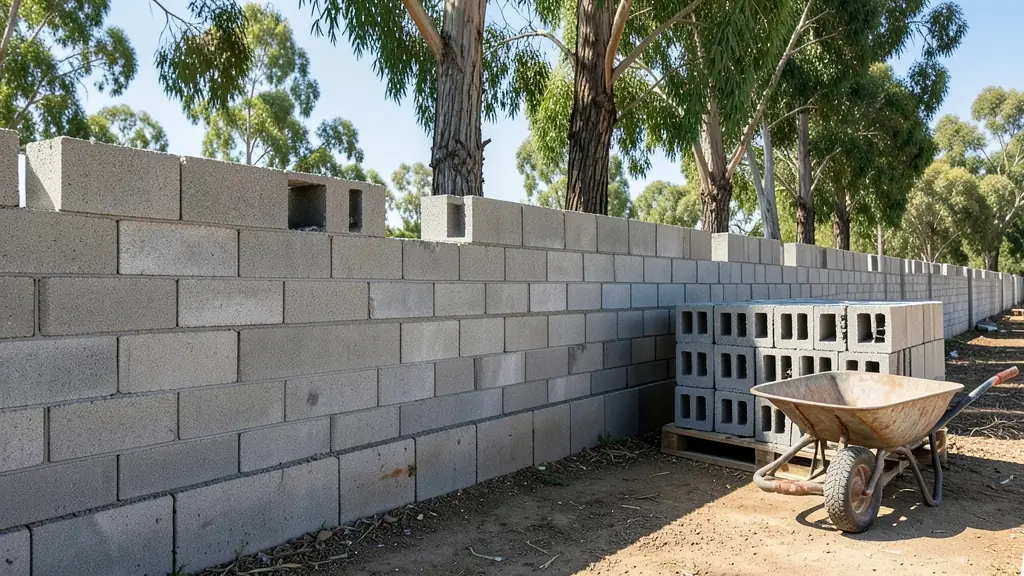
Concrete blocks are large hollow units made from cement, sand and stone, used for boundary walls, factory and warehouse walls, outbuildings and many houses in South Africa. A common hollow block shows a 390 x 190 mm face and comes in 90, 140 and 190 mm widths, so about 12.5 blocks build a square metre against 52 standard bricks. That means fewer courses and faster walls. This page covers block sizes, how to choose, laying, reinforcing and prices. Send one free, no-obligation request and block yards near you quote you directly.
Concrete block types
- Hollow blocks: two or three cores through the block, the most common type and lighter to carry.
- Solid blocks: heavier, for walls that carry more load or need more mass.
- Split face and coloured blocks: a rough or coloured face for walls left unplastered.
- Half blocks and lintel blocks: for wall ends, openings and bond beams.
- Retaining wall blocks: a separate shape built to hold back soil.
Like cement bricks, they are concrete masonry units under SANS 1215.
Concrete blocks sizes in South Africa
The width does the work:
- 90 mm: inside partitions and light non load-bearing walls.
- 140 mm: the everyday block for boundary walls, outbuildings and many house walls.
- 190 mm: taller and heavier walls, and walls that need steel and concrete in the cores.
All show about 390 x 190 mm on the face, so about 12.5 per m², plus 5% spare. A boundary wall 40 m long and 2.1 m high is 84 m², so about 1,050 blocks plus about 55 spare. Your plans or an engineer say which width and strength each wall needs. For smaller jobs, maxi bricks are an option.
Laying blocks: steel, piers and mistakes
Blocks are laid in mortar on a level footing with a damp-proof course, just like bricks, but a long block wall needs more thought. Boundary walls usually need piers or reinforced cores at intervals and brickforce or a bond beam to limit cracking, and tall walls in windy spots need design. Common mistakes:
- no movement joints on long walls, so cracks appear;
- filling cores with weak, dry concrete or not at all;
- laying green blocks that have not cured;
- a shallow footing on clay soil.
New buildings follow SANS 10400. A bricklayer used to blockwork sets out the courses well.
Concrete blocks price and what to ask
A 140 mm hollow block usually costs about R10 to R18, and a 190 mm hollow block about R15 to R25, collected from the yard. Delivery, strength, quantity and a split face or colour change the price. Ask the yard:
- the width, block type and strength, and whether they are tested to SANS 1215;
- how many blocks a pallet holds;
- the delivered price and how the load is offloaded;
- whether half blocks and lintel blocks are available.
Want to make them yourself? See block making machines.
What to include in your request
- Give the block width: 90, 140 or 190 mm
- Say hollow, solid or split face
- Give the number or the wall size
- Ask for half and lintel blocks too
- Give the delivery address and site access
Concrete Blocks for different clients
- Homeowners: 140 mm hollow blocks for a boundary wall, garage or back room
- Builders and bricklaying contractors: block walls on outbuildings and houses that go up in fewer courses
- Housing developers and complexes: hollow blocks for estate perimeter walls and complex boundary walls
- Brickyards and block yards: block yards making 140 and 190 mm hollow blocks on static machines
- New brick-making businesses: a small block making business supplying builders with 140 mm hollow blocks
- Farms and smallholdings: block walls for sheds, pump houses, feed stores and dairy buildings
- Municipalities, schools and public works: blocks for municipal depots, school boundary walls and community buildings
- Landscapers and paving teams: split face block garden walls and block planters on outdoor jobs
Frequently asked questions
What is the price of concrete blocks?
How many concrete blocks per square metre?
Are concrete blocks cheaper than bricks?
Can I build a house with concrete blocks?
Concrete Blocks by province and city
- Johannesburg
- Pretoria
- Centurion
- Midrand
- Sandton
- Randburg
- Roodepoort
- Krugersdorp
- Randfontein
- Germiston
- Boksburg
- Benoni
- Kempton Park
- Alberton
- Vanderbijlpark
- Vereeniging
- Durban
- Pinetown
- Pietermaritzburg
- Richards Bay
- Newcastle
- Ladysmith
- Gqeberha (Port Elizabeth)
- East London
- Kariega (Uitenhage)
- Mthatha
- Cape Town
- Bellville
- Paarl
- Stellenbosch
- George
- Worcester
- eMalahleni (Witbank)
- Middelburg
- Secunda
- Mbombela (Nelspruit)
- Rustenburg
- Brits
- Klerksdorp
- Potchefstroom
- Mahikeng
- Polokwane
- Tzaneen
- Kimberley
- Upington
- Bloemfontein
- Welkom
- Sasolburg