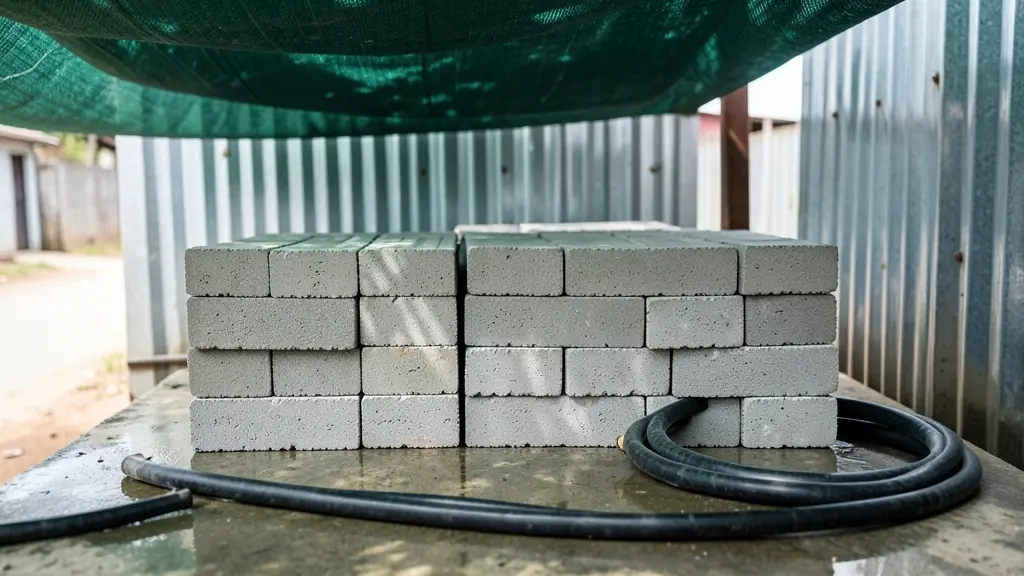
Cement bricks are the grey bricks you see stacked at block yards and on building sites from townships to suburbs. They are made from cement, sand and water, compacted in a mould and cured, rather than fired like clay. That makes them cheap and quick to produce, which is why so many small brick businesses start with them. Most are cement stock bricks meant to be plastered. This page covers the sizes, strength, curing and what a cement brick costs. Send one free, no-obligation request and yards near you quote you directly.
Cement brick types
- Cement stock bricks: about 222 x 106 x 73 mm, the everyday brick for plastered walls.
- Maxi bricks: about 290 x 140 x 90 mm, fewer per m².
- Hollow and cored bricks: lighter, with holes through.
- Cement face bricks: coloured or textured cement bricks for walls left bare.
- Blocks: bigger hollow units from a similar mix with stone added.
All of these are concrete masonry units under SANS 1215, sold by compressive strength in MPa.
Cement bricks size and strength
A standard cement brick lays at about 52 per m² in a single skin and 104 in a double skin, plus about 5% spare. Sizes vary slightly between moulds, so buy the whole job from one yard. Strength matters more than size. Plastered walls, load-bearing walls and foundations may call for different strengths, so take your plans to the yard and ask what strength the bricks are and whether they are tested. Bricks that crumble at the corners or scratch easily are a warning sign. Heavy, dense, square bricks with sharp edges are a good start.
How cement bricks are made and cured
The mix is cement, sand (sometimes stone or ash) and just enough water, compacted in a mould on an egg-laying or static brick making machine. The fresh bricks are then cured: kept damp and out of strong sun and wind for about the first week, and they keep gaining strength for weeks after. Common faults:
- too little cement in the mix, to save money;
- dirty or clayey sand;
- bricks dried out by hot wind or washed out by summer storms;
- bricks sold and laid too soon, which then crack.
Highveld frost can also damage bricks in their first nights.
Cement bricks price and what to ask
Cement stock bricks usually cost about R1.80 to R2.50 each at the yard, roughly R1,800 to R2,500 per 1,000, with delivery extra. Price follows strength, quantity and distance; a yard close to the site can save a lot on transport. Ask the brick supplier:
- the strength in MPa and whether bricks are tested to SANS 1215;
- how old the bricks are and how they were cured;
- the price per 1,000 delivered and the smallest load;
- whether you can collect with a bakkie or trailer.
What to include in your request
- Give the number of bricks
- Say the strength your plans ask for
- Ask how long the bricks have cured
- Say collect or deliver, and the address
- Ask for the price per 1,000
Cement Bricks for different clients
- Homeowners: cement bricks for an extension, a garage or a plastered boundary wall
- Builders and bricklaying contractors: bulk cement stock bricks from a nearby yard to cut transport costs
- Housing developers and complexes: cement bricks of a set strength for RDP and social housing phases
- Brickyards and block yards: the core product of most block yards, made daily and cured in rows
- New brick-making businesses: the usual first product for a new brick business with a small machine
- Farms and smallholdings: cement bricks made or bought locally for stores, kraals and staff houses
- Municipalities, schools and public works: cement bricks for public works housing, ablution blocks and school classrooms
- Landscapers and paving teams: cement bricks for plastered garden walls, planters and braai stands
Frequently asked questions
What is the price of cement bricks?
What size is a cement brick?
Are cement bricks better than clay bricks?
Can I make my own cement bricks?
Cement Bricks by province and city
- Johannesburg
- Pretoria
- Centurion
- Midrand
- Sandton
- Randburg
- Roodepoort
- Krugersdorp
- Randfontein
- Germiston
- Boksburg
- Benoni
- Kempton Park
- Alberton
- Vanderbijlpark
- Vereeniging
- Durban
- Pinetown
- Pietermaritzburg
- Richards Bay
- Newcastle
- Ladysmith
- Gqeberha (Port Elizabeth)
- East London
- Kariega (Uitenhage)
- Mthatha
- Cape Town
- Bellville
- Paarl
- Stellenbosch
- George
- Worcester
- eMalahleni (Witbank)
- Middelburg
- Secunda
- Mbombela (Nelspruit)
- Rustenburg
- Brits
- Klerksdorp
- Potchefstroom
- Mahikeng
- Polokwane
- Tzaneen
- Kimberley
- Upington
- Bloemfontein
- Welkom
- Sasolburg