
Understanding the Basics of Brick Manufacturing
What Is Brick Manufacturing?
Nearly 1.5 billion bricks are produced in South Africa every year, yet few people know the professional name for this work. The process of making bricks is called brickmaking, and it demands far more than simply pressing clay into shapes. I visited a factory in Johannesburg and saw the entire operation.
The sequence unfolds in precise stages:
- Quarrying and weathering the raw clay.
- Crushing and screening to remove impurities.
- Mixing with water and sand to achieve the right consistency.
- Moulding the blend into uniform blocks.
- Drying for several days to remove excess moisture.
- Firing in a kiln at up to 1,200 degrees Celsius.
A single mistake in timing during that last stage can ruin thousands of units. Watching this process, I gained a new respect for every wall built in this country.
A Brief History of Brick Making
Few crafts carry the weight of history like brickmaking. The process of making bricks is called brickmaking, and it has barely changed in six thousand years. Mesopotamian builders stacked sun-dried mud. Roman legions transported kiln-fired units across their empire. In South Africa, the same transformation occurs daily, turning earth into permanence.
The basics of this ancient trade are few:
- Selecting clay with the right plasticity.
- Shaping it into moulds by hand or machine.
- Baking it until the particles fuse into solid stone.
Each stage demands patience. A brick remembers its making. The fire that hardens it also seals its story.
Types of Bricks and Their Applications
Choosing a brick is a matter of character. While the process of making bricks is called brickmaking, the final product varies more than most people expect. Clay bricks remain the backbone of South African construction, prized for thermal mass and durability. Concrete bricks offer speed and uniformity, which explains their popularity in housing estates where time is money. Engineering bricks resist moisture and serve as the quiet workhorses of foundations and retaining walls. Face bricks carry the aesthetic load, and they are the only ones that truly need to look good.
Typical applications follow a familiar logic:
- Clay bricks for load-bearing walls and fireplaces.
- Concrete bricks for internal partitions and boundary walls.
- Engineering bricks for damp-proof courses and sewer work.
- Face bricks for exterior cladding and feature walls.
Each type earns its place through physical properties, not nostalgia. The process of making bricks is called brickmaking for a reason: it is a making, not a guessing game. A well-chosen brick respects both the climate and the craftsman’s hand.
Raw Materials and Preparation
Clay as the Primary Raw Material
Raw clay pulled from a South African quarry is rarely ready for the moulding table. The process of making bricks is called brickmaking, and it hinges on the preparation of this primary material. Deposits must be tested for plasticity, shrinkage, and the presence of lime or iron oxides. A single overlooked stone can ruin an entire batch.
Once approved, the clay is weathered, crushed, and screened. Water is then added during tempering to create a uniform, workable mass.
Critical factors in clay preparation include:
– Moisture content must be kept consistent
– Organic matter must be broken down completely
– Particle size must be fine enough to prevent cracking
This stage sets the physical properties of every brick that follows. If the clay is prepared poorly, nothing downstream can correct it.
Additives and Their Roles
Here is a concrete fact: adding a half percent of barium carbonate can prevent efflorescence, a white powdery stain that mars brick faces.
Additives fine-tune clay behaviour. While clay provides the body, additives control shrinkage, colour, and durability. The process of making bricks is called brickmaking. It demands precise additive dosages.
- Lime reduces drying shrinkage, though excess creates expandable particles that pop after firing.
- Iron oxide imparts red to brown hues and lowers the vitrification temperature.
- Sand, or grog, tempers plasticity, preventing cracks during hand moulding.
Each additive alters thermal response. A wrong proportion yields brittle units regardless of clay quality. Knowing these roles saves resources and protects your reputation.
Crushing and Grinding
Before clay meets water, it must be broken down. The process of making bricks is called brickmaking, and it begins with crushing oversized lumps into manageable fragments. A primary crusher reduces rocky clay to pieces smaller than a fist, while secondary grinding mills pulverise it to a consistent powder.
This stage determines everything downstream. Poor grinding leaves hard nodules that create weak spots in the fired body. Correct fineness improves mixing, so water and additives distribute evenly. Oversized particles also slow drying and cause hidden cracks.
A typical preparation line includes:
– Jaw crushers for hard claystone
– Roller mills for medium hardness
– Sieves that reject oversize material
South African clays vary widely, so operators must adjust grinder settings for each batch. Moisture content changes how materials behave. A dry clay grinds finer but generates dust, while damp clay clogs screens. I have seen many a batch ruined by treating two different clays the same way. Balancing these factors tests the skill of any brickmaker.
Blending and Mixing
The first meeting of clay and water is a moment of transformation. In the brickmaker’s alchemy, this is where the true character of the batch is forged. It is a physical process that demands patience; the goal is to achieve a homogenous mass where every particle has been kissed by moisture, eliminating pockets of dryness that would otherwise become fractures.
It is crucial to remember that the process of making bricks is called brickmaking for a reason: it is a craft of precise steps. During mixing, the water content must be meticulously monitored, as a variance of just a few percent can spell disaster. Masons often speak of “working the body” to reach a plasticity where the clay can be shaped without sticking, a state that feels like soft leather. In modern plants, this is achieved in a pug mill, which extrudes the clay under immense pressure, but the principle remains ancient.
However, there is a darker side to preparation. The impurities that hide within the raw earth are often only revealed after firing. For this reason, the blending stage is also about control. Common offenders include:
– Lime stones, which “pop” and crumble after the heat has passed.
– Organic matter that burns away, leaving unwanted voids behind.
Because of these risks, a savvy plant operator always tests a sample batch before committing to full production. A veteran I met on the Highveld once told me that in his youth, he skipped this step, and the kiln emerged with entire sections turned to glass. The process is unforgiving. Even the temperature at which the fire rises must be planned here, in the mixing phase, as the result will determine whether the final product is a solid, weatherproof block or a brittle husk. Once the blend is homogenous, it is left to age in a “sour” pile for days, allowing the moisture to penetrate the densest lumps. It is a quiet, dormant period, but it is here that the integrity of the wall is truly decided, long before the brick ever sees the fire.
Wetting and Aging
Wetting is where the clay begins to change. The process of making bricks is called brickmaking, and the preparation stage dominates its timeline. Water is added incrementally, never in a single pour, until the mass reaches a saturation point that precedes true plasticity.
I have seen rushed operators in Gauteng skip the aging phase, and the extrusion line suffers for it. A covered pile of tempered clay rests for 72 hours or more. During that dormancy:
- moisture migrates from wet zones to dry ones;
- clay particles swell as water enters their structure;
- stubborn aggregates dissolve under sustained humidity.
The brick’s structural integrity is decided here, before the shaping tables and the kiln.
Forming the Bricks
The Stiff-Mud Process
From the pug mill, the homogenized clay emerges with a moisture content of approximately 12 to 15 percent. This is the critical window for the stiff mud process, where the mixture holds its shape yet remains workable. The clay is forced through a vacuum chamber to remove trapped air pockets, preventing cracks during drying.
Next, the de aired column is pushed through a rectangular die at the extruder’s mouth. This continuous column of clay, known as a slug, then travels along a conveyor belt. Here, the machine performs the precise act of cutting. A wire harp slices the slug into individual bricks of uniform size and density. The speed of the belt and the wire’s frequency determine the final brick length.
The handling options at this stage are straightforward, though they yield different surface characteristics.
These freshly cut units, still soft and moisture laden, must now be transported to the drying yards. Their journey requires gentle handling to avoid deformation seals. Each brick carries the latent structure of the final product, waiting for the heat that will lock its form permanently. The slug can also be directed into a horizontal auger machine for a higher compression ratio, though this is a less common variation for standard building units.
The Soft-Mud Process
The process of making bricks is called forming, and at this stage, precision matters. After the stiff-mud column leaves the extruder, a wire harp cuts it into individual units. The spacing between wires sets the brick’s length, and the speed of the conveyor dictates the final dimensions. These fresh bricks have a rough texture, a result of the cutting action.
Depending on the desired finish, manufacturers choose their next step. A wire-cut brick moves directly to drying. For a smoother face, the brick is pressed again in a steel mould. This operation compresses the surface and creates sharp edges.
– Wire-cut bricks offer a textured, natural look.
– Pressed bricks have a dense, smooth surface, ideal for facing work.
– Molded bricks require a sand coating to release cleanly from the mould.
Once shaped and treated, the bricks are fragile. They must move to the drying yards without vibration. Any deformation at this point becomes permanent, so careful handling is essential. The plastic clay is vulnerable, but the path to the kiln is now set. The process of making bricks is called forming, and it concludes here, with the wet brick ready for the next critical phase.
The Dry-Press Process
Barely ten percent of the world’s bricks emerge without a whisper of added water. This is the dry press process, a method that prizes precision over plasticity. Clay, crushed to a fine powder and containing only a fraction of its weight in moisture, is fed into steel moulds. There, immense hydraulic pressure, often exceeding several hundred tons, compacts the material. The grains fuse, not by stickiness, but by sheer mechanical force. The process of making bricks is called compaction here, and it yields a unit with incredibly tight tolerances.
This technique produces a brick that is sharp, dense, and remarkably uniform. It does not require the lengthy air-drying of its wetter cousins. The immediate rigidity allows for stacking and curing without racking. These units often feature sharp arrises and a smooth face, making them desirable for specific architectural details.
– The dry press excels at producing frogged bricks, where indentations aid mortar adhesion.
– It is ideal for high-strength applications, such as paving or load-bearing walls.
– The low water content prevents warping during the rapid firing cycle.
The process of making bricks is called dry pressing, and it requires a careful balance. Too much pressure creates laminations, while too little results in a crumbly edge. The powder must flow evenly into the die, a challenge solved with mechanical feeders. The result is a modern product shaped by ancient materials, a testament to engineering over tradition.
Extrusion and Cutting
The dry-press method’s precision is remarkable, but it represents just a fraction of global output. For the vast majority of bricks, the journey begins in a far more fluid state. Here, the homogenized clay mixture is forced through a machine that shapes its future.
This is the extrusion process. Imagine a colossal, industrial-sized meat grinder, but instead of creating mince, it forces the de-aired clay through a rectangular die. The result is a continuous, dense column of clay with a perfect cross-section. This column, often called a “pug,” slides along a conveyor belt, its surface smooth and ready for the next phase. The pressure involved is immense, compacting the material to remove air pockets that would otherwise cause weaknesses or cracks during firing.
Once the column emerges, the cutting begins. A taut wire, thinner than a guitar string, slices the continuous column into individual brick units. This happens with remarkable speed and accuracy, ensuring every brick has an identical length and clean faces. The speed is adjustable, allowing manufacturers to produce standard modular bricks or longer structural units.
This combination of extrusion and cutting offers several key advantages for modern construction, namely:
– High volume: The continuous process produces thousands of bricks per hour.
– Uniformity: Every unit shares the exact same dimensions and density, ensuring consistent performance.
– Versatility: The die can be changed to create different profiles, including bricks with holes (perforations) that reduce weight and improve thermal insulation.
– Cost-effectiveness: The automated nature of the line reduces labor costs significantly.
The freshly cut bricks, still soft and pliable, are then loaded onto drying racks. They retain their shape because the clay was de-aired and compacted so thoroughly. The tighter the extrusion, the less moisture remains, which is a key factor in preventing warpage during the subsequent drying and firing stages. It is this careful control of moisture and pressure that determines whether a wall will stand for a century or crumble in a decade. This entire phase of production, from the pug column to the wire-cut unit, is a masterclass in mechanical efficiency. The process of making bricks is called forming, and in this method, it is a lesson in precision. The strength of the final product is dictated here, long before it ever meets the kiln’s fire.
Molding by Hand
Before the roar of machinery, there was the slap of clay against wood. Hand molding is the oldest way to shape a brick. The process of making bricks is called forming, and here it happens without a single machine.
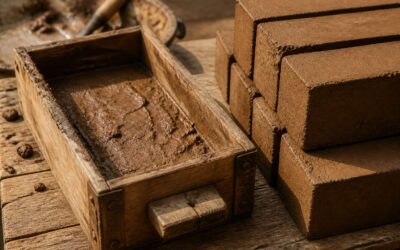
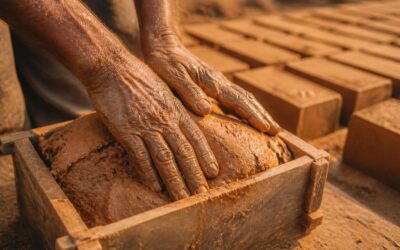
A worker takes a lump of prepared clay and throws it into a sanded wooden mold. The mold sits on a bench. The worker strikes off the excess clay with a straightedge, leaving a clean edge. Then the mold is lifted, and the raw brick is left to dry on the ground. It is slow, deliberate work.
This method produces bricks with a distinct, rustic character. They often have a smooth face on one side and a rougher texture on the other. The sand used in the mold leaves a fine grit on the surface, which helps the brick bond with mortar.
Each brick formed by hand is slightly different from the next, and that small variation gives a wall a living texture that machines cannot copy.
Drying and Firing
The Importance of Drying
Consider that a single degree of temperature fluctuation during the final heating can turn a perfect brick into a cracked, worthless shard. This is the brutal reality of drying and firing, the fiery crucible where all the careful preparation meets its definitive test. The water is the enemy here. Even after the extrusion or molding, a brick still contains up to a quarter of its weight in moisture. Rushing this stage, forcing the water out too quickly with excessive heat, creates a phenomenon called case hardening. The surface dries and shrinks, locking moisture inside, which then expands violently as steam, blowing the brick apart from within.
The drying process is a delicate dance of time and atmospheric pressure. Bricks are often left in the open air for days, or moved into climate controlled chambers that slowly draw out the moisture. This gradual evaporation is crucial.
– The pace must be slow to prevent hairline fractures forming within the clay body.
– A consistent relative humidity prevents the outer shell from drying faster than the core.
– Even the stacking pattern matters, allowing for uniform airflow around every single brick.
After the final traces of water evaporate, the brick enters the kiln for firing. The temperature climbs steadily, pushing out chemically bound water that remains in the clay minerals. At over 900 degrees Celsius, a phenomenon called vitrification begins. The silica and alumina particles soften and fuse, fusing into a glassy, unbreakable matrix. The firing schedule is orchestrated with precision, passing through stages like dehydroxylation and carbon burnout, each one stripping away volatile elements. The process of making bricks is called a transformation, where raw earth becomes stone, forged not by magic, but by the relentless, unforgiving application of heat.
Drying Methods: Air and Artificial
Loading the Kiln
Once the clay has shed its moisture in the drying sheds, the real alchemy begins. This is the stage where the process of making bricks is called into its final, transformative act: the firing. The kiln is the crucible, and how we load it determines the character of every brick that emerges. It is a meticulous dance of placement, ensuring heat can circulate freely around each unit to guarantee even burning and consistent color.
The firing schedule is a carefully orchestrated progression. We begin with a gentle preheat to drive off any lingering water, then slowly raise the temperature to around 1000 degrees Celsius. This intense heat vitrifies the silica particles, fusing them into a durable, glass-like matrix. A controlled cooling period follows, which is just as critical as the heating, as a rapid temperature drop can cause cracking.
> We often stack the green bricks in a specific pattern, leaving flues between the rows. This isn’t just for efficiency; it’s about controlling the atmosphere inside. More airflow creates an oxidizing environment, which produces the classic red color, while restricting oxygen can yield darker, blue-toned bricks.
The result is a product that stands up to the harshest South African sun and the heaviest rains. From the initial clay pit to the final, ringing solid brick, each step relies on the discipline of the previous one. The intense heat of the kiln is the great equalizer, turning a soft, malleable earth into the sturdy backbone of our buildings. It is the point of no return, where all the earlier preparation is proven in fire.
The Firing Process and Temperature Ranges
The fire is the final arbiter. It decides if a brick will hold a building for a century or crumble in a single season. This stage transforms raw clay into a permanent material, and it all begins long before the flames touch the surface.
Once the formed bricks leave the drying sheds, they enter the kiln. Residual moisture must be removed slowly in the early stages. Rushing this causes steam to expand inside the body, creating cracks or, worse, a catastrophic explosion inside the kiln chamber. The temperature climbs gradually, usually over several hours, to allow this water to escape harmlessly.
As the heat intensifies, the chemical structure of the clay changes. At roughly 900 degrees Celsius, the mineral particles begin to sinter. They soften slightly and fuse together. By the time the temperature peaks, often around 1000 to 1200 degrees Celsius, the silica has transformed into a glassy matrix that binds the entire brick into a solid, monolithic unit.
The atmosphere inside the kiln is equally important. A steady flow of oxygen produces the rich red and orange hues common to South African face bricks. Reducing the oxygen supply creates darker, purplish or blue-toned bricks by altering the iron oxides in the clay. This control requires precise timing and constant attention.
The cooling phase is just as delicate as the heating. The bricks must come down from peak temperature gradually, allowing the ceramics to stabilize. A sudden drop in temperature can cause “cooling cracks” that render the batch unusable. Once sufficiently cooled, the kiln doors are opened, and the true test of the process is revealed: a stack of building blocks ready for the rigors of the Highveld sun and the winter rains.
Cooling and Unloading
The kiln doors groan open, and the heat escapes like a held breath. Cooling is where the brick earns its patience. A slow descent prevents thermal shock, which can shatter a batch in seconds. We monitor the temperature drop over days, not hours. Once the chambers reach a safe warmth, unloading begins.
Forklifts glide through the aisles, palletizing bricks that still radiate warmth. The process of making bricks is called a craft precisely because every stage demands attention. No rush survives contact with clay. Each brick is inspected for:
- hairline fractures
- warped edges
- uneven color
A single flaw means rejection. This moment, after hours of fire and days of cooling, reveals the true character of the material. The stack stands ready for the Highveld sun.
Quality Control and Final Steps
Inspecting for Defects
The kiln doors swing open, and the heat rolls out in a wave that carries the scent of finished earth. This is the moment of truth for every brick. After days of intense firing and the slow, deliberate cooling that followed, each unit now faces the most critical phase. We call this the sorting floor, and it is here that craftsmanship meets rigorous standards.
To the untrained eye, a pallet of bricks looks uniform. Yet, the skilled eye catches the subtle variations that determine strength and longevity. We listen for the clear, metallic “ring” that signals a perfect vitrification. A dull thud is the first sign of a defect. We also measure each brick against strict dimensional tolerances. A fraction of a millimeter can throw off an entire mortar bed on a construction site.
Our team looks for specific issues during this final inspection. These checks are vital to ensure structural integrity:
– Cracks and fissures: Hairline fractures can expand under load, compromising the wall’s stability.
– Chipped corners and edges: These affect the aesthetic finish and the ease of laying.
– Lime pops: Small, chalky spots that appear due to unreacted lime, causing spalling later.
– Warping or twisting: A distorted brick makes laying difficult and creates weak points in the masonry.
It is a labour-intensive process, but one that saves time and money for builders down the line. We take pride in ensuring that only the best materials leave our yard. The relentless sun and sudden Highveld storms demand materials that can endure. A brick that passes our scrutiny is a promise of permanence in a landscape of constant change. The process of making bricks is called a cycle of transformation, and this final sorting is its most honest evaluation.
Packaging and Storage
Once the kiln has been opened and the bricks have passed through the initial cooling phase, they face their final hurdle before shipment. This stage determines whether a brick earns a place on a building site or gets relegated to the crusher for recycling. It is a process of physical inspection, sound testing, and precise measurement, ensuring that only the strongest units represent the batch.
The sorting floor is where the subtle differences between a durable product and a structural liability become apparent. Workers typically perform a series of rapid checks to gauge the quality of each unit. A simple tap with a hammer reveals internal fractures; a healthy brick rings with a clear, high-pitched tone, while a cracked one emits a dull thud. They also look for surface blemishes that could affect mortar adhesion or weather resistance. These manual inspections are essential because they catch the visual and auditory cues that automated scanners might miss.
The criteria for rejection are strict, and for good reason. A single defective unit can compromise the integrity of an entire wall. The most common defects found during this phase include:
– Lime pops: Small, chalky white spots caused by unreacted lime that expand when wet, eventually popping out and leaving pockmarks in the wall.
– Shrinkage cracks: Hairline fractures that occur during the drying process, weakening the brick’s structural load capacity.
– Chipped corners: Damage that prevents a clean, uniform mortar joint and detracts from the finished aesthetic.
– Efflorescence: A white, powdery salt deposit that, while not always structurally damaging, indicates poor soluble salt content in the raw clay.
This process is a key reason why the process of making bricks is called a craft rather than just an industrial output. The human eye still plays an invaluable role in maintaining consistency.
Once the inspection is complete, the approved bricks progress to packaging and storage. The primary goal here is protection from the elements and physical damage during transit. Bricks are highly porous, meaning they can absorb significant amounts of water if left exposed to rain. Therefore, they are typically stacked in tight cubes and either shrink-wrapped in heavy-duty plastic or strapped with steel bands. This packaging secures the load for transport and prevents moisture ingress that could affect the mortar bond later.
Storage also requires a strategic approach. Yards often keep inventory organized by type and compression strength, allowing contractors to locate the specific material they need without disturbing other stacks. These storage areas are usually laid out on compacted, well-drained ground to prevent the bottom layer of bricks from sitting in water. Forklifts and other heavy machinery then move these stable cubes to waiting flatbeds, ensuring the journey from the plant to the mason’s site is as smooth as the production process itself. This final logistics phase completes the journey, confirming that the process of making bricks is called a cycle for a reason, ending only when the product is placed safely in the hands of the builder.
Environmental Considerations in Brick Making
A single hairline crack can silence an entire delivery, which is why quality control carries such weight in this industry. The process of making bricks is called many things, yet precision remains its defining characteristic. Every unit undergoes scrutiny for dimensional accuracy and structural integrity. The environmental considerations receive equal attention. Water used during cooling is recycled back into the production loop, reducing waste significantly. Heat recovery systems capture residual warmth from the kiln to pre-dry future batches. Dust suppression techniques keep the air clear and the workspace safe. Some facilities implement rainwater harvesting to supplement their supply. This dedication to minimizing the ecological footprint ensures the craft remains sustainable. Quality and care converge in these final steps, creating a product that stands the test of time.
Innovations in Brick Production
While the process of making bricks is called brickmaking, its final phase has transformed into a digital discipline. Automated optical scanners now examine every surface for microcracks that the human eye might miss, while ultrasonic testing verifies internal density without damaging the unit.
These innovations extend to handling. Robotic arms equipped with soft grippers arrange bricks in patterns that optimize airflow during curing. Some plants use embedded sensors that log moisture levels in real time, feeding data to a central system that adjusts drying parameters automatically. I have seen this reduce reject rates by nearly a third in a single season.
- Sintering curve analytics to refine firing profiles
- Computer vision for edge geometry verification
- RFID tags for batch traceability
Each step reinforces reliability. The process of making bricks is called a craft, but modern quality control turns it into a precise science, ensuring every pallet meets exacting standards.
0 Comments